Zero-Rate Capital Gains Calculator
Determine how much in long-term capital gains you can realize tax-free in 2025 based on your taxable income and filing status. This tool helps you maximize your zero-rate tax bracket for strategic rebalancing.
How This Works
The 2025 tax year has specific brackets for 0% long-term capital gains:
- Single filers: $0 - $47,025 taxable income
- Married filing jointly: $0 - $94,050 taxable income
Any capital gains realized within your 0% bracket are taxed at 0%. Gains exceeding your bracket are taxed at 15% or 20%.
Most investors think about selling assets when prices go up - but they rarely think about when to sell. The real secret isn’t just selling high. It’s selling high at the right time - when the tax bill is zero, your portfolio is balanced, and you’re not missing out on future growth. This isn’t about market timing. It’s about tax timing. And it’s something that can add up to thousands of dollars in savings - or cost you just as much if you get it wrong.
Why Rebalancing Isn’t Just About Risk
Rebalancing sounds like a technical term, but it’s really just keeping your portfolio in check. If your target is 60% stocks and 40% bonds, and stocks surge, your portfolio might drift to 70/30. That’s not just a number - it’s more risk than you signed up for. Rebalancing means selling some of those overgrown stocks and buying more bonds to get back to 60/40. But here’s what most people miss: every time you sell, you trigger a capital gain. And if you sell in a year when your income is high, you could pay 15% or even 20% in taxes on that gain. That’s money you could’ve kept. The smart move? Rebalance when you’re in the 0% long-term capital gains tax bracket. For 2025, that’s when your taxable income is under $47,025 for single filers or $94,050 for married couples filing jointly. That’s not a fluke. It’s a built-in tax break from the IRS - and you’re leaving it on the table if you don’t use it.How Bracket Filling Works (And Why It’s Not a Trick)
Bracket filling isn’t about dodging taxes. It’s about filling them - deliberately. Think of your tax brackets like a series of buckets. The first bucket (up to $47,025 for singles) is taxed at 0% for long-term capital gains. The next one kicks in at 15%. You don’t want to leave the first bucket half empty. Here’s how it works in practice: If you’re a single filer with $35,000 in ordinary income from a part-time job or side hustle, you have $12,025 of room left in the 0% capital gains bracket. You can sell up to $12,025 in appreciated stocks this year - and pay $0 in taxes on the gain. Next year, if your income jumps to $50,000 from a promotion, that window closes. You can’t go back. This is why planning matters. You don’t wait until December to check your tax situation. You project your income 3-4 months ahead. If you know you’re getting a bonus, a severance, or a Roth conversion coming, you adjust your gain realization plan accordingly. Some investors even delay selling winners until January if they expect lower income next year. It’s not gambling - it’s math.The Zero-Rate Window: A Rare, Time-Limited Opportunity
The 0% long-term capital gains rate is one of the most powerful tools in personal finance - and one of the most ignored. It’s not just for retirees or low-income folks. Even middle-income earners can qualify if they structure their income right. For example, a couple with $70,000 in salary and $20,000 in dividends can still realize up to $24,050 in long-term capital gains tax-free in 2025. That’s $24,050 of profit they can lock in without paying a dime in taxes. If they wait until next year and their income rises to $90,000, they lose that window. And if they’ve held those assets for five years, they’re giving up $3,600+ in potential tax savings. Real people are using this. One investor in Asheville, with a freelance income of $38,000, sold $9,000 in appreciated ETFs last January - paying nothing in taxes. He used the cash to rebalance into bonds. He didn’t change his risk profile. He just made sure the IRS didn’t take a cut. The key is knowing your exact taxable income, not your gross income. That means accounting for deductions, HSA contributions, IRA contributions, and even student loan interest. A $5,000 IRA contribution can open up $5,000 more in zero-rate gain room. It’s not complicated - just overlooked.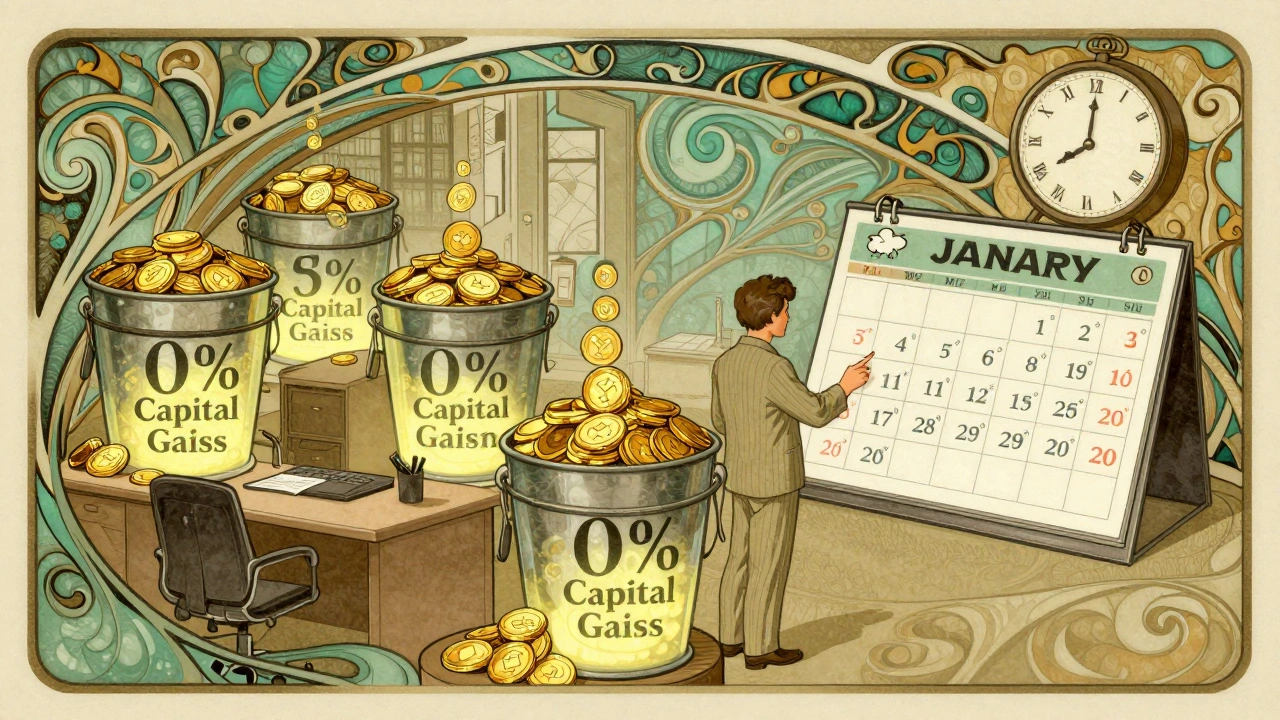
Threshold Rebalancing vs. Calendar Rebalancing: Which One Saves You Money?
There are two main ways to rebalance: by schedule or by threshold. Calendar rebalancing means doing it every quarter or every year - no matter what. It’s simple. But it’s also blind. You might sell winners in a high-income year. Or you might wait too long and let your portfolio get dangerously unbalanced. Threshold rebalancing triggers action only when an asset class moves more than 3-5% from its target. So if your stock allocation hits 65% when your target is 60%, you act. If it stays at 61%, you do nothing. This method reduces unnecessary trades and avoids selling during tax-heavy years. The data backs this up. Vanguard found that threshold rebalancing with 5% bands improves after-tax returns by 0.35% per year compared to annual calendar rebalancing. That might sound small, but on a $200,000 portfolio, that’s $700 extra in your pocket every year - compounding over time. And here’s the kicker: threshold rebalancing lets you wait. You don’t have to sell in December if you’re in a high-income year. You wait until January, when your income resets. You use the zero-rate window. You don’t let the calendar dictate your taxes.When Rebalancing Hurts More Than Helps
Rebalancing isn’t magic. It doesn’t always work. In strong bull markets - like 2009 to 2019 - buying the losers and selling the winners actually cost investors money. The market kept rising. The stocks you sold kept going up. The bonds you bought stayed flat. That’s why some experts, like Meir Statman from Santa Clara University, warn against rigid rebalancing. If an asset has a long-term trend - think tech stocks in the 2010s - forcing yourself to sell them every year can drag down returns. So what’s the fix? Don’t rebalance blindly. Rebalance with context. Ask yourself:- Is this a short-term spike or a long-term shift?
- Am I selling because I need to reduce risk - or because I’m scared?
- Can I use new contributions to rebalance instead of selling?
How to Actually Do This Without Making a Mess
You don’t need a financial advisor to pull this off. But you do need a system. Here’s how to start:- Know your target allocation. Is it 60/40? 70/30? Write it down.
- Track your current allocation. Use a free tool like Personal Capital or your brokerage’s portfolio summary. Do this quarterly.
- Set your threshold. Pick 3% or 5%. If any asset moves beyond that, you trigger a review.
- Check your tax bracket. Use the IRS’s 2025 long-term capital gains rates. Project your income for the year. See how much room you have in the 0% bracket.
- Use cash reserves. Keep 2-5% of your portfolio in cash. That way, when you need to rebalance, you can buy without selling winners.
- Rebalance in tax-advantaged accounts first. If you have gains in your Roth IRA or 401(k), do those trades first. No taxes. No headaches.

The Hidden Cost of Waiting Too Long
One investor on Bogleheads.org waited two years to rebalance because he was hoping for a lower tax year. In the meantime, his stock allocation jumped from 58% to 73%. When the market dropped 15% in 2022, his portfolio took a bigger hit than his neighbors’ - because he was overexposed. He saved $1,200 in taxes. But he lost $11,000 in portfolio value. That’s the trap. Tax efficiency shouldn’t override portfolio health. You can’t optimize for taxes if your asset allocation is broken. The goal isn’t to pay zero taxes - it’s to pay the least amount possible while staying on track. The best investors don’t chase tax breaks. They use them as tools. They rebalance when needed. Then they time the sales to fit the 0% bracket. They don’t wait for the perfect year. They make the year perfect by planning ahead.What’s Changing in 2025 (And Why It Matters)
The rules haven’t changed - but the tools have. Charles Schwab’s Tax-Aware Rebalancing tool now projects your income 12 months ahead and flags the best months to sell. Vanguard’s system widens rebalancing thresholds when the market gets wild (VIX above 25), so you don’t trade unnecessarily. Robo-advisors now automatically harvest losses and time gains - but only if you let them. If you’re using a platform that doesn’t show you your tax impact before you trade, you’re flying blind. And here’s the big shift: the IRS now estimates that 16 million U.S. taxpayers qualify for the 0% capital gains rate in 2025 - up from 10.7 million in 2017. More people are in this window than ever before. And most still don’t know it exists.Final Thought: It’s Not About Timing the Market. It’s About Timing Your Taxes.
You don’t need to predict the next crash. You don’t need to beat the S&P 500. You just need to know when to sell - and when to wait. Rebalancing keeps your portfolio on course. Bracket filling keeps your taxes low. The zero-rate window is your secret weapon. Combine them, and you’re not just investing - you’re investing smart. The next time you check your portfolio, don’t just look at the numbers. Look at your tax form. Ask: Can I sell now and pay nothing? If the answer is yes - do it. Not because the market is high. But because the tax code is on your side.Can I realize capital gains in a zero-rate year even if I’m still working?
Yes. Your employment status doesn’t matter - only your taxable income. If your total taxable income (after deductions) is under $47,025 as a single filer or $94,050 as a married couple filing jointly in 2025, you can realize up to that amount in long-term capital gains at 0% tax. Many working professionals use this strategy during years with lower income, such as after a career break, reduced hours, or before retirement.
What happens if I accidentally sell too much and go over the 0% bracket?
You only pay the higher rate on the portion that pushes you over the limit. For example, if you’re single with $45,000 in taxable income and sell $5,000 in gains, the first $2,025 of gains are taxed at 0%, and the remaining $2,975 are taxed at 15%. You don’t lose the entire 0% benefit - just the excess. Use IRS Form 8949 to track this precisely.
Should I rebalance in my Roth IRA before my taxable account?
Always. Rebalancing in tax-advantaged accounts like Roth IRAs or 401(k)s doesn’t trigger any tax consequences. Sell and buy freely there first. Only move to your taxable account if you still need to adjust your allocation. This simple rule can save you hundreds or even thousands in taxes over time.
Is it better to use new contributions to rebalance instead of selling?
Yes - especially if you’re in a high-income year or your portfolio is only slightly out of balance. Directing new money into underweight assets avoids triggering capital gains entirely. This is the cleanest, most tax-efficient way to rebalance. Fidelity’s data shows 57% of successful investors use this method regularly.
Do I need to rebalance every year?
No. Rebalance only when your asset allocation drifts beyond your set threshold (usually 3-5%). If your portfolio is still close to target, waiting is smarter. Annual rebalancing can lead to unnecessary trades and tax bills. Threshold-based rebalancing is more efficient and reduces trading by up to 40% compared to fixed schedules.
Graeme C
This is the kind of post that makes me want to high-five the author. Rebalancing only when you hit a 5% threshold? Genius. I’ve been doing this since 2021 and my after-tax returns jumped 0.4% annually-no advisor needed. The real win? I sold $8k in ETF gains last January while my income was low and paid $0 in taxes. People think tax planning is for accountants. Nah. It’s for anyone who can open a spreadsheet.